
I headed to Happy Divers at eight o'clock this morning to complete my fourth dive for the advanced PADI course. During the first three dives I worked on required skills for advanced certification, but for the fourth and fifth dives I was allowed to choose from a list of approved skills. I really wanted to do a wreck dive and EJ was happy to accomodate me.
In 1987 Anthony's Key Resort, near the west end of Roatan, sunk an old Peruvian cargo-liner just off the coast to allow divers easy access to an underwater shipwreck. There are other wrecks near Roatan, the newest of which is a cargo ship that went belly-up while bringing rum and hammocks to the island, but the Peruvian wreck is apparently the most accessible and the most interesting. EJ briefed me on the wreck before we got in the water. He mentioned that there are several grouper fish that hang around the wreck waiting for food from divers, as well as a giant green moray eel that lives in the sunken ship. EJ nodded approvingly as he told me about the eel, “He's real friendly, you'll like him.”
I descended into the water and followed EJ as he pulled himself along a rope leading 100 feet down to the site of the wreck. For a couple of minutes all I could see was EJ, the rope, and the dark blue ocean beneath me. Slowly, as I reached the sandy bottom, the wreck came into view. Diving the wreck really was an out-of-this-world experience. From the bottom of the ocean I looked down the side of the massive cargo liner. I followed it's main mast up with my eyes until the top of it ended about fifty feet shy of the surface of the water. EJ and I thoroughly explored the wreck, swimming past metal ladders and beneath giant masts that have long since been covered with coral. The experience was like something out of a video game or a movie, it was almost hard to believe I was really under the water looking at the thing.
We swam to the rear of the ship and as I turned to my left I saw the eel that EJ had told me about. I quickly grabbed my camera and swam towards the eel, who was hiding under a sheet of metal, excited to get a picture of the thing. After snapping a couple of shots I realized the eel was slowly slithering towards me through the water, as if to tell me to quit invading it's space. Being approached by a six-foot, girthy eel while 100 feet down was an experience I wasn't prepared for. I was pretty startled and I quickly swam backwards. Finally the eel retreated back into it's hiding place. EJ led me away but spoke up later in defense of the eel. “You did sneak right up on him”, he told me matter-of-factly.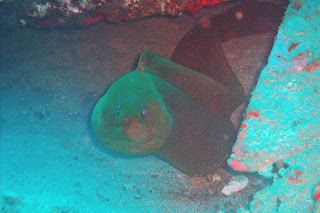
For my final dive of the advanced PADI course I visited a site called “Hole in the Wall”. The idea was to work on underwater photography and I did get a few pointers from EJ and took a few good shots, but more than anything the dive was just another fun underwater experience. EJ led me 90 feet underwater and up into a swim-through that led to a more shallow reef of coral. The swim-through opened up about thirty feet beneath the surface and we spent the rest of the dive in shallower waters, searching for a few good photo ops. The highlight of the dive was spotting two trigger fish; a blue one that swam by us at the beginning, and a silver one that we passed towards the end. I couldn't help but be reminded of diving at Ko Tao in Thailand, where it's easy to spot a few giant, multi-colored trigger fish on every dive.
During the last few days I've been pretty unsure about my itinerary for the remaining week of my trip in Costa Rica. Originally I wanted to spend some time at Monteverde cloud forest as well as a couple Pacific coast beaches, one of which is known for it's diving and another which is known for it's surfing. After really giving it some thought though I've decided that I don't need that much more time on beaches this trip. Beaches are great but I'm more satisfied with adventurous, cultural experiences than with beaches. It all finally came together late this afternoon when I made a small discovery in my Lonely Planet book. Only five hours by bus from San Jose, Costa Rica is a Nicaraguan town where visitors can take a boat down a narrow river, lined with trees and winding past tiny villages. After a three hour ride the boat arrives at a seventeenth century Spanish fortress, strategically placed to stop foreign invaders and pirates from reaching the colonial town of Granada. The Spanish fortress thing is perfect for my itinerary. Not only will I get to visit Nicaragua and have an experience that contrasts well with the rest of my trip, but it also sets me up perfectly to visit a couple of national parks, a waterfall, some caves, and Monteverde forest on my way to spending my last day or two on a perfect Costa Rican beach.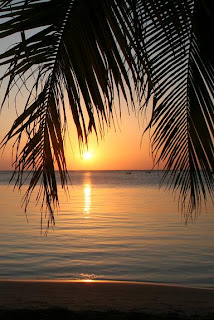
Wednesday, February 13, 2008
Wreck Dive

Tuesday, February 12, 2008
PADI Diving Course

I woke up this morning to my iPod alarm clock blasting rock music through the headphones at the other end of the room. I could tell from the song that the playlist had been going for a while and it turned out that I had slept thirty-three minutes through the alarm and was already late for my diving class. The great thing about Caribbean islands though is that everyone is late for everything, so it really was no big deal. I brushed my teeth and pulled on my swimsuit, bought some breakfast at a grocery store next door, and headed to Happy Divers.
I found out pretty quick today that Happy Divers isn't exactly a run-of-the-mill dive shop. I originally chose the place because it was the first dive shop I went to that could offer me an advanced PADI course on Tuesday and Wednesday. I didn't pay much attention to anything else, least of all to the fact that no place could fit the description “hole-in-the-wall” more accurately than Happy Divers Dive Shop. The place is run by two Jamaican guys: a fiftyish manager named James and a younger boatman named David (his introduction to me was classic, “David is de name!”). The great thing about a smaller dive shop though is that they can offer each individual diver more attention. When I got my first level of diving certification at Buddha View Dive Resort on Ko Tao in Thailand I was one of six or seven divers sharing the same instructor. This morning when I walked into Happy Divers there was a freelance PADI diving instructor named EJ waiting for me. I'm his only student for the duration of the course.
I loaded my equipment into Happy Divers' fifteen foot fishing boat and headed out with James and EJ to “Lighthouse #2”, the first dive site of the day. The advanced PADI course is two days long and requires five different dives. On each dive you work with an instructor to improve a different diving skill. At Lighthouse #2 I completed the “Deep Dive” requirement for the PADI certification. EJ and I descended to 120 feet and found a patch of sand to kneel on. For the first few minutes EJ completed a couple of demonstrations. First he cracked an egg and let the yolk out into the water. The pressure at 120 feet kept the yolk from splitting open and it floated freely in a spherical shape into the ocean. Next he pulled out a card that he had showed me while we were at the dive shop. The card had the words “Red, Purple, Blue, Green, Yellow, Orange, Brown” written on it, each in their respective colors. Above water the colors matched, but deep in the ocean the word “Red” looked purple and “Brown” looked black. Apparently red light is filtered out under the water. Finally EJ had me work out some math problems, spell my last name backwards, and draw an elephant on a small chalkboard. I passed the test easily enough but the demonstration was interesting - my mind was impaired a bit due to the high level of nitrogen breathed in at such a deep depth. I wouldn't want to take the GMAT at 120 feet down.
After a short break we headed to “Blue Channel”, another dive site near the bay. This time the test was navigation. I took a few minutes at the beginning of the dive to demonstrate that I could accurately swim patterns through the ocean using a small compass. For the remaining forty minutes of the dive EJ and I went exploring for a massive seven foot eel that other divers had spotted in the area. EJ led me through a swim-through at Blue Channel (like a cave but with an entrance at one end and an exit at the other) where we spotted a bright blue and yellow spanish hogfish. Later in the dive we did spot an eel, but not the seven-footer. EJ pointed out a golden-tailed moray eel peering out of an opening in the coral. Eels apparently will stand their ground pretty well. I swam right up to the thing and took a few pictures and it didn't back even an inch away into it's hole.
The last dive of the day was at a site called “Divemaster's Choice”. EJ and I spent the first ten or fifteen minutes of the dive working on buoyancy. One of the greatest challenges for beginning divers is learing to control their movement under the water. Ideally a diver will be able to maneuver using only small kicks of the fins and the natural buoyancy resulting from air breathed into the lungs. Flailing the arms and legs is a no-no and is a revealing sign of an inexperienced diver. It can be a lot of fun learning to get the hang of buoyancy control. A lot of times I'll see a mound of coral directly in front of me and by taking a deep breath of air I become more buoyant and rise above it in time to pass over it. It's equally fun to spot a creature fifteen feet below and blow all my air out to sink down and take a closer look. The concept sounds simple, but really getting the hang of it is like learning to walk all over again. The natural reaction is to flail the arms and legs in a desperate attempt to get where you're going.
When I finished the buoyancy tests EJ led me along the side of a one-hundred foot wall of coral as we looked for creatures under the water. He pointed out to me a sea cucumber covered with yellow spots and winding three or four feet through the coral. Towards the end of the dive I noticed a couple of sheets of corroded metal resting sixty feet down on the ocean floor. A few minutes later we came to the remains of a thirty foot boat that probably sunk years ago. I enjoyed observing the small bits of coral that had started to grow on the sheet metal and the engine. As EJ signaled that the dive was over I noticed a giant grouper fish near the bottom. He had made a home of the small wreck and was peering around the edge of the boat, looking up at us as we ascended to the surface. 
Monday, February 11, 2008
Roatan

This morning I took a pretty sickening ferry ride over the bumpy Caribbean to the Honduran island of Roatan. I rode with the Kennedys, the Irish couple who I had dinner with last night. Their company was enjoyable, but I'm pretty sure that mine wasn't. Before getting on the ferry I had a pretty gross breakfast taco at the cafeteria at the pier. By the end of the ride I had regurgitated the entire thing into a garbage can, along with whatever else was in my stomach at the time. After wiping my mouth and staring at the floor for about twenty minutes I looked up and saw that the Kennedys had relocated to the other side of the ferry. I've never been seasick before but I guess there's a first time for everything. This trip has been full of first-time experiences, some more enjoyable than others. John Kennedy and his wife took a chance on me and split a cab to the west end of the island and I was off for some more classic Caribbean island scuba diving.
Roatan is a scuba diver's paradise. The island is packed with hole-in-the-wall Caribbean restaurants and local dive companies. The competition for business is so fierce on Roatan that the island has become widely known as the cheapest place to scuba dive in the world. Twenty-five bucks here will buy you a boat ride and a one-hour guided tour of the bottom of the ocean. For five more bucks the rental of your fins, mask, wetsuit, and diving equipment is included.
After hopping off the cab I wandered into the nearest dive shop, “Happy Divers” and booked an advanced open water PADI course for Tuesday and Wednesday. The advanced PADI course will earn me my next level of PADI diving certification, which will certify me to dive up to thirty meters deep instead of the current eighteen and will also certify me to go on wreck dives and night dives. It probably doesn't really make a difference if I have the advanced certification or not, as most dive companies will take you on any dive as long as you have the first level of certification, but I figure it'll be fun to go through the course and all the different dives that are required for the advanced class.
I booked a couple dives for this afternoon with “Coconut Tree Dive Company”, down the bumpy dirt road from “Happy Divers”. In the hour before my first dive I found a hotel and dropped off my stuff, e-mailed home two days worth of stories and pictures, got a quick lunch at a grocery store, and gathered up my rented diving equipment and hauled it onto the boat.
The first dive of the day was at a site called “Fish's Den”, about a ten minute boat ride east of the Coconut Tree dive shop. I don't think that Roatan has the giant eagle rays, sea turtles, and sharks like Belize has, but there's lots of smaller stuff that's worth seeing. I probably could ever get bored with diving in the Caribbean. During the hour spent at Fish's Den I saw many of the incredible coral formations typical of Caribbean diving as well as a giant blue parrot fish and a small sea turtle.
Fish's Den was a lot of fun and I figured that would be the highlight of the day but my next dive, at a site called “Dixie's Place”, turned out to be even better. The dive started off pretty normal, with lots of smaller stuff, but a couple sightings later in the dive were pretty enjoyable. Martin, the guide from Coconut Tree, pointed out a hawkbill sea turtle in the distance and I swam over with a few other divers to check it out. It really was a pretty funny sight, the turtle was shoving his head into a cluster of coral and pawing at it with his fin like a dog searching for his bone in a hole in the backyard. I can only guess what was in there but regardless of what it was the sight was pretty funny. The turtle was completely oblivious to the fact that six divers were hovering only a few feet overhead. He just kept pawing away at the coral, determined to evict whatever was inside. Only a few minutes later we crossed paths with another sea turtle, this one about three feet in diameter. Sea turtles aren't shy by any means. I swam right up to the thing with my underwater camera and he swam even closer to me, completely unintimidated by a larger creature in the ocean. I snapped a few shots as he paddled by and went about his business.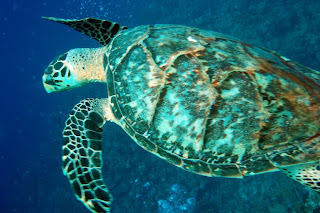
I think I've finally figured out the underwater photography thing. For the first six dives of the trip it was so hard to get any pictures to turn out because there's so little light sixty feet down in the ocean. All my shots looked great when I framed them up and snapped the shutter, but later when I looked at them they'd all be deep blue with a few barely distinguishable figures in the distance. The trick is that to get any color at all you have to use the flash and get as close as possible to the subject. On my last dive today at Dixie's Place I finally figured that out and even got some pictures with bright red, green, and yellow hues instead of the typical blue mess.
I chatted with our guide, Martin, for a few minutes between dives and he has a pretty interesting story. Martin spent two years diving in Thailand and Malaysia, five years diving elsewhere in the Caribbean, and has been on Roatan for one year so far. Most of the diving he has done has been commercial and industrial - building and recovering stuff under the water, but for the last little while that he's worked as a scuba guide leading people in explorations under the ocean.
It's interesting to hear about the lives of the people I meet while traveling. Most of these people have such a unique outlook on life. At home it seems to be so easy for people to stretch themselves into a mortgage and car payments that they can't afford. A lot of people will accumulate every last material thing that banks will give them credit for and then they spend so much time working to pay for it that they forget to live. The result is hundreds of millions of Americans who devote their lives to paying interest and creating a profit for financial institutions. In the meantime there are guys like Martin who live a simple life and don't have a whole lot of material things, but do have an incredible lifestyle and amazing experiences literally every day. I think everyone just has to have their balance. Nothing's wrong with having material things and living a traditional lifestyle as long as you make time to really live. 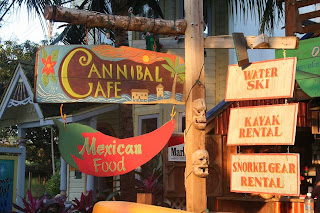
Dinner tonight was at a tacky place called The Cannibal Cafe, “Where weed like to have you for dinner!!!”. The food wasn't too memorable, but the rest of my night was alright. Later on, as the sky grew darker, I wandered aimlessly along the coast. An older guy with a British accent rushed to introduce himself to me and was excited to introduce his friend as well. His German buddy supposedly was the driver for Heimlich Himmler during World War II. These older guys were way funny. I was in more of a philosophical mood than a laughing mood tonight, but these guys got a few chuckles out of me. Most of the humor was so profane that I tried not to laugh and would never repeat it in the journal, but some stuff was good clean fun. The British guy showed me a few quotes scrawled onto his food kiosk with a Sharpie marker. All of them were good for a laugh, but my favorite was probably one that read, “It's not your fault you're American, it's ours. Signed The British Empire.”
Sunday, February 10, 2008
Copan Ruins

This morning I enjoyed a tasty Honduran breakfast at a local restaurant and then took a rickshaw half a mile out of town to the Copan Ruins. The Copan Ruins aren't nearly as massive as the ones at Tikal, but there are hundreds of intricate Mayan carvings that draw all the visitors. As I entered the site the jungle opened up to reveal a massive grass-covered plaza, at least the size of a football field. Covering the plaza were several “stellas”, Mayan carvings depicting animals, ancient hieroglyphics which told complete stories, and depictions of the rulers of Copan. Many of the carvings were of a ruler named “King 18 Rabbit”. It was easy to spend over an hour just in that first plaza snapping pictures of the Mayan artwork. It really is pretty amazing how much of it there is and how well preserved it all is. Ancient artwork is always an interesting insight into lost civilizations, and the artwork at Copan is no exception.

After an hour or so in that first plaza I wandered past the “ball court” which, according to an English speaking tour guide that I overheard, was used in ancient times for athletic competition.The ball court was a strip of grass running down the middle of two stone ruins that were slightly inclined on each side. Carvings of macaw heads line the sides of the ball court. It was fun to imagine what kind of games the Mayans might have played in such a structure.
I wandered further through the ruins past the “hieroglyphic staircase”, sixty-three steps, each of which is inscribed with Mayan hieroglyphics. I followed a path through the trees and up a hill leading to the top of the largest pyramid at Copan. The pyramids at that end of the complex were impressive, but my favorite part over there was the amazing views. While climbing up the hill I looked to my left through dark sillouettes of trees and vines and saw the ball court and other ruins gleaming in the sun below me. I snapped a few pictures of the view, but nothing is quite as impressive as seeing and wandering through it in real life.
I had a quick lunch at Glifo's and then it was time for another journey by bus, this time to La Ceiba, Honduras, a gateway city to the country's famous Bay Islands. The novelty of traveling by bus through Central America has worn off a bit, but the time still passes quickly, especially when I meet a few interesting people along the way. On the way to La Ceiba I talked for a while with an Alaskan guy who lived for two years in Nicaragua and comes back down to Central America often to travel and to visit friends he made while he was down here. Everyone I've talked to who has really spent time in Nicaragua says that it is a less developed country, but it's an incredible place to visit and every bit as safe as the rest of Central America.
I really wish I could visit Nicaragua now, but it might be too much of a stretch with the limited time that I have left. I'm flying to Costa Rica on Thursday and could easily catch a bus up to Nicaragua, but I'm not sure that I want to burn that much time heading all the way up there and all the way back down again. In retrospect I should have booked my flight to Managua, Nicaragua instead of to Costa Rica, then I could fly in and work my way down. In hindsight, though, everything is twenty-twenty. There was no way I could have known when I booked my flight that I would have wanted to do that. Costa Rica should still be a lot of fun though. I think I'll visit the Monteverde rain forest, scuba dive at Playas del Coco, and maybe take surfing lessons at Playa del Tamarindo, another beach further down the Pacific coast.
After arriving in La Ceiba I arranged to split the cost of a room with a German guy named Thomas, who I met on the bus. After dumping off our stuff at the hotel we met up with an Irish couple named the Kennedys (ironically enough the guy's first name is John) and we all headed off to a local restaurant for dinner.
You know a place is good when everybody else there is local. The place we ate at tonight was that kind of place, it was awesome. I ordered one of the cheaper meals and was expecting something pretty meager. When my plate came though it seriously was massive. My five dollars bought me steak, chicken, and chorizo, accompanied by beans, onions, some kind of awesome Honduran cheese, and a stack of warm tortillas. It was fun to have dinner and chat with such a diverse group of people. The Kennedys traveled through Southeast Asia a few years ago so it was a lot of fun to talk with them and compare our experiences.
Tomorrow I'll head to Roatan, one of the Bay Islands, for more scuba diving and relaxation. It'll feel good to chill out for a bit before moving on and cruising through Costa Rica.
Saturday, February 9, 2008
Copan Town
People are so laid back down here that nothing seems to run on a schedule, the time for anything to happen is whenever people feel like it. Take bus rides for example. In the United States you'd call ahead to a Greyhound station, ask about their schedule, and buy a ticket for a bus that would leave at a specific time on a specific day. Down here you wait on the side of the road and wave down the first bus going in your direction. During my journey today from Coban, Guatemala to Copan, Honduras I rode on no fewer than six different busses. Fortunately all the locals down here are very helpful and they were happy to point me in the right direction so I was waiting in the right place for the right busses. One bus I rode was a van built to hold nine or ten passengers that had a roof piled high with avacados and thirty-two people inside. I can only imagine how Guatemalans could fill the St. George house.
I was surprised by how beautiful the town of Copan is. I was expecting a dusty little Honduran village, existing only to facilitate the needs of travelers visiting the nearby Mayan ruins. It really is a very nice place though. The town is set in a lush green valley and has a beautifully designed Central Plaza surrounded by a whitewashed colonial-style cathederal and several tasteful restaurants and shops. It is a bit touristy, but it's classy at the same time, it isn't overdone.
This afternoon I took a rickshaw to a place just outside of town called “Parque de Aves”. The Parque de Aves is a reserve and rehabilitation center for exotic birds indiginous to South and Central America. This place really was outstanding. Again it was a bit touristy, but not kitchy or tacky, it was the real deal and was very well done, even by United States standards. I don't even really like birds but this place had some pretty awesome ones. During my one-hour tour by a park employee I walked through an enclosure with ten or fifteen colorful scarlet macaws, saw several varieties of bright green and red birds from all over the amazon, and even let a toucan gnaw on my fingers (trust me, it wasn't painful at all). My favorite part of the park though was an area where visitors could have their picture taken while holding one of several different varieties of birds. I gave my camera to a Honduran kid and had my picture taken with several different species of macaws as well as a smaller exotic bird that was perched on my finger.
As the sun set over Copan I hiked up a cobblestone street to the “Mirador de Cuartel”, which I think means, “view from the jail”. The jail is a whitewashed building that looks like it was built to sell Whitecastle burgers, but I'm pretty sure it isn't being used - either to house prisoners or to sell burgers. The view was worth the short hike though. I climbed a little ways down the hillside and snapped a few pictures of the town at sunset against the green hills, as well as a few pictures of a local soccer game taking place at a field nearby.
I figured that ten dollars wasn't an outrageous price to eat dinner at Copan's finest restaurant, so I went to “Glifo's” for a tasty meal. I enjoyed minestrone soup with garlic bread as well as filleted fish with a Mayan corn sauce and mashed potatoes and vegetables on the side. I was still hungry after such an exhausting day of bus rides, so I went to the Central Plaza and paid another dollar for a grilled sausage with tortillas, beans, and picante sauce.
Copan is a fun town at night. As I wandered around after dinner I stopped to watch a man performing Native American sounding music (Mayan, perhaps?). I also passed a semi-tasteful night market where for less than a dollar I bought a Mayan statue that is clearly manufactured, but still worthy of my collection back home.
I'm really looking forward to visiting the Copan Ruins tomorrow. With Tikal they are the most famous Mayan ruins outside of Mexico. Tikal was great because each of the temples was so huge, but Copan is known for it's abundance of Mayan carvings. My friend Mark, who I met in Belize, said that he enjoyed Copan even more than Tikal, so I'm pretty excited to see what it's all about.
Friday, February 8, 2008
Semuc Champey
 Semuc Champey is easily one of the four or five most beautiful places I've been to in my life. My expectations were high after seeing the photos that my friend Mark who I met in Belize showed me and I was not let down. Originally I was somewhat paranoid about Guatemala because of everything that's written and said about the dangerous conditions down here, so I was planning on spending one day to see Tikal and another day to hustle South to Honduras. Everything I've heard from travelers who have been here recently though is that it's perfectly safe and it's an absolutely gorgeous country. That description has turned out to be far more accurate. After talking to Mark about Guatemala I changed my entire itinerary for the first part of my trip so that I could spend more time in the country, and after four days here I wish I had planned for more. Tikal, Antigua, and Volcan Pacaya were all outstanding and were well worth the time I budgeted for them. Budgeting time for Semuc Champey was a risk because I had to burn a day to get here and a second day to see it, but the experience was well, well worth it.
This morning I took a bus three hours through winding dirt roads in the mountains to a tiny village called Lanquin. From Lanquin I was planning on catching a cheap bus or pickup truck the remaining six miles to Semuc Champey, but after waiting on a street corner for a half-hour, I decided I had better get walking. A Guatemalan man who lives near Semuc Champey shared my predicament and for several miles I walked with my new Spanish speaking friend, Secondino.
The people in Guatemala really are so friendly. Secondino didn't speak a word of English, but using my very limited Spanish we were able to communicate. We joked around a little bit and Secondino showed me several “mascortos” (shortcuts) through tiny jungle paths, which saved me quite a bit of walking. I hope that when people stereotype Guatemala as a dangerous country they don't include the people here in their stereotype. Everyone I've met in Guatemala is at least as friendly as the people I know from back home. Everyone has been very welcoming and is excited to get to know foriegners and even help out a little bit with Spanish. Several times while in the country a local has noticed me flipping through my guide book and has come up to see if he can help me find what I'm looking for. I think that, as is unfortunately the case with many cultures and ethnic groups, a very small minority of troublemakers give the entire population of Guatemala a bad reputation. I'm sure that ninety-nine people out of a hundred here are as friendly and genuine as people come.
After a six mile walk that was pleasant because of the views but tiring because it was up and down mountainous dirt roads in my flip-flops, I finally arrived at Semuc Champey. There are only a few places I know of in the world where people say the water is “so clear that you can see to the bottom”, and when you get there it actually is. A few of those places I can think of are Koenig See in Germany, Kwang Xi Falls in Laos, and Ko Tao in the Gulf of Thailand. Now I can add Semuc Champey to the list. Semuc Champey is a series of sparkling turquoise waterfalls and pools cascading down the middle of a massive jungle-covered canyon. The fact that it's so hard to get to does great things for this place, because otherwise it would be absolutely swarming with tourists and anyone else who found out about it. As it is, I enjoyed one of the most beautiful sights in the world with fifteen or twenty other people who made the trek from Coban this morning.
After a refreshing swim through a couple of crystal-clear pools at the base of the canyon, I hiked about a mile up a trail to see a classic view of the natural wonder. The view from the top of the canyon really was incredible. The narrow green canyon opens up at the beginning of the falls and tapers outwards to reveal the gorgeous, turquoise pools. After enjoying the view and chatting with some other travelers for a few minutes, I headed down the canyon and made conversation with a Guatemalan tour guide.
To avoid having to walk back to Lanquin or possibly being stranded and having to return to Coban tomorrow morning, I arranged with the tour guide to pay to ride their van back at the end of the day. It worked out well for everyone because the tour guide got an extra fifty quetzales from me and I effectively became part of a tour that would otherwise have cost two hundred seventy five quetzales.
After some more diving and swimming in the pools, I followed my new tour group along the pools to a spot where a rope ladder was draped over the side of a thirty foot waterfall. One by one each of the travelers climbed over the edge of the waterfall and onto the precariously hanging ladder. This was one of those times when I looked at what was going on and thought to myself, “this would never fly in the United States”. In the US a tourist will scratch his arm or bump his knee and sue the travel agency for thousands of dollars. Then he'll go after the National Park Service and the individual travel guide who led him over the side of the ladder. So the result is that travel agencies in the US are limited to what is deemed acceptable by the legal system, and even then they'll have their clients sign a pile of liability waivers before they can do anything. The great thing about countries like Guatemala is that the legal system is so backwards that travel agencies are free to do whatever they feel is adventurous.
I climbed carefully down the ladder and at the bottom a giant cave opened up behind the waterfall. Inside the cave were dark pools filled by showers of water dripping down from the stalagtites above. Our guide threw a rope down a slope leading further into the wet cave and we each took turns sliding underneath a low ceiling of stalagtites and down the side of the dripping cave wall. From the bottom this cave bore a serious resemblance to The Penguin's cave in the movie, “Batman Returns”. A giant underground river raged past me and underneath the massive cavern of grey mineral formations. I could picture The Penguin and all his clown friends standing on the other side of the river and peering right back at me. Danny DeVito would feel right at home here.
Before heading back to Coban we stopped at a place called “Grutas de Lanquin” (Lanquin Caves). For an hour or so we wandered through a second, larger set of caves. Our guide told us that the Mayans used the Grutas de Lanquin for animal sacrifices. The human sacrifices were apparently done elsewhere. The most entertaining part of the Grutas de Lanquin was the different natural formations resembling animals and the accompanying signs placed by locals to mark them. The formations resembling a soaring eagle, a toad, and a hanging, dead sheep were interesting, but my favorite was “El Mono”, a natural rock formation resembling the wiley-eyed face of a mischevious monkey. 

Thursday, February 7, 2008
Coban
My friend Mark, who I met in Belize, showed me some pretty incredible pictures of a place in Guatemala called Semuc Champey, so I decided I had to go there. Semuc Champey isn't exactly in a convenient part of Guatemala. I'd have to burn a day on a bus to a city called Coban, near Semuc Champey, but I decided it would be worth it.
One great thing about spending a day on a bus through Guatemala was that I got to see several different parts of the country, and I got to see the lanscapes change from one place to the next. After heading a few hours north of Antigua the lush, green hills had changed to a grassy, cactus filled desert. The bus passed through several small villages on the way, a few of which resembled miniature Antiguas, complete with pastel-colored storefronts and small, colonial style cathederals. Soon enough the landscape turned back into tree-covered mountains and hills and by the early afternoon I was in Coban.
My sightseeing time was limited today since I spent so much time on the bus, but I was able to visit a place called “Finca Santa Margarita”, or in English, Santa Margarita Farm. During the 19th century German immigrants moved to Guatemala and settled in Coban. Many of them founded coffee farms and became very influential in the area. During World War II the United States pressured Guatemala to deport the German immigrants, many of whom were supporters of the Nazi party, but the coffee farms remained.

Fortunately I showed up just in time for the last tour of the day and I was off to explore the coffee farm with four Swedish girls and a Guatemalan guide. Despite the fact that I don't drink coffee and really am not interested in coffee except to see how it is produced, the tour of the farm was enjoyable. The guide began the tour by leading us through narrow paths lined with different varieties of coffee plants. She picked the beans of several of the plants and gave some to each of us to smell. Later in the tour we saw a small facility where the beans are separated from the fruit, an area where beans are laid out to dry in the sun, and a room where coffee beans are roasted and packaged. The whole factory was pretty low-tech as far as manufacturing is concerned, but it was funny to me that at the very end a Guatemalan hombre was packaging the beans in attractive bags that would look tasteful in any American coffee shop. People buying Guatemalan coffee beans in the United States would never guess that the coffee they are buying is packaged at factories using equipment that was out of date fifty years ago. I always enjoy long conversations with people of different ethnic backgrounds. At the end of the tour I sat down with the four Swedish girls as we were all given a cup of coffee to try (I pretended that I just don't like coffee). We talked a lot about stereotypes of different cultures. For some reason I asked if everyone in Sweden genetically has blonde hair and blue eyes (a really lame question on my part, especially considering I've been to Sweden and have seen people there without blonde hair and blue eyes, but in my defense, all four of these girls had blonde hair and blue eyes). One of the girls made a good point and asked if everyone from Salt Lake City has blonde hair and blue eyes. She said that everyone asks the same questions about Sweden: first, if everyone has blonde hair and blue eyes, and second, if it snows all the time. One girl said that while traveling in China she met quite a few locals who thought that polar bears roam freely in the streets in Sweden. The stereotypes they had about America were about the same as I've heard from other travelers. On the bright side Americans make the greatest TV shows in the world and we're very patriotic. On the ugly side we're generally known as being ignorant of other cultures and we drink a lot of Coke and we're fat. I told them that I'm fat too, but that I hide it with a girdle.
Late this afternoon I really wanted to visit the “Templo el Calvario” on a hill overlooking the city. Unfortunately the sun was already setting and I've promised myself that I won't wander around alone after dark while I'm in Guatemala. I feel like Will Smith in the movie, “I Am Legend”. Everything is fair game during the day, but when the sun starts to set I've got to head straight for my hotel in fear of the wild creatures that might appear outside after dark. With any luck I'll have some time tomorrow, after visiting Semuc Champay, to see the Templo el Calvario before the sun sets.
I did have a chance to (cautiously) brave the dark city streets near my hotel as I searched for a place to eat dinner tonight. I played it better-safe-than-sorry, hid my money belt with my passport underneath a mattress in my hotel room, and left for dinner with only my room key and one hundred quetzales in my pocket.
I decided it was high time for me to have some really authentic Guatemalan food and I figured there was no better way to do it than to eat like many of the locals do - from a street vendor at the city's central plaza. Using my best Spanish, which is more accurately described as “severely mangled” than “broken”, I ordered two plates of “churrascos” from a street-side booth. I don't know exactly what a churrasco is, but what I got was a pile of grilled tortillas with steak, onions, and Guatemalan picante sauce on the side. Guatemalans know how to make a good taco (for the sake of simplicity, we'll call these things tacos). The street food from Coban would rival the best tacos at a Mexican restaurant in the States, and would absolutely blow away the concoctions at Taco Bell. After getting my food I sat on a flimsy plastic stool next to two Guatemalan men and piled my tortillas high with steak and picante sauce. I must have looked like a high-roller ordering two plates of the stuff on a whim, but for twenty quetzales (two dollars and fifty cents), it didn't exactly break the bank.
On my way back to the hotel I stopped at a kiosk on the side of the road to buy a bottle of water. Again, my Spanish fell short and there was a lack of communication between myself and the guy behind the counter, so to save face I just ordered an orange Fanta instead. After another struggle to communicate I realized that the bottle wasn't included in the price so I sat at the kiosk and sipped my Fanta, which I really didn't even want in the first place. While sipping away a lady next to me noticed my Spanish phrasebook and was completely intrigued by it. The lady, Gladys, asked how much it cost and flipped through several of the pages and suddenly I was in the middle of a conversation with her as well as Enrique, the guy manning the kiosk. I joked around a bit with the two Guatemalans and we taught each other a few words in our respective languages before I finished my Fanta and was off.
Trying to have conversations in Spanish is a lot of fun, even though I usually have no idea what the other person is saying or how to respond. It would be nice if I had learned a bit more before I came down here, but I find it much easier to learn now that it's a necessity to eat and get a hotel room every day. Even though there was no mind-blowing sight or experience today, it has been worthwhile just to keep things low-key for a change. Wandering around in Coban today gave me more opportunities to speak Spanish than I've had during the last few days combined. Originally I counted this day as one that would be “burned” in transit, but it really has been worthwhile. After visiting Semuc Champay tomorrow I think I'll feel like I've seen quite a bit of Guatemala.
