I took a quick flight from Nyaung U to Mandalay this morning, dropped my stuff off at a hotel and e-mailed home, and then headed off to see the city. My first stop of the day was at Mandalay Hill. Buddhists must have a thing for building stupas on top of hills. It seems like every hill in Southeast Asia that's near a city or town has some kind of golden stupa or other Buddhist structure built on it. Also, the larger the city is, the more stuff they build on their hill. Close to one million people live in Mandalay. Their hill is apparently a very big deal to them.
The climb to the top of Mandalay hill takes thirty or forty minutes and involves climbing up few thousand concrete steps. I climbed barefoot, as is required, passing buddhist shrines cov ered in mirrors and gold leaf on the way. I stopped for a few minutes to chow down on a couple of bowls of noodles that I bought from a lady on the hill, then I kept going. I couldn't help wondering if climbing steps to a shrine represents something to Buddhists. Perhaps it represents our journey through life and an ascent to becoming more like the Buddha. Or perhaps it is some kind of reenactment of Buddha's enlightenment. Or maybe it means nothing and they just need a way to get to their shrine on the top of the hill. Either way, I kept climbing. I passed several large shrines on the way, one of which had a standing, gold-leaf-covered Buddha that was about fifty feet tall. Other shrines featured golden-colored Buddhas surrounded by flashing colored lights, or Buddhas with LED lights blinking in a circular pattern behind their heads. The blinking lights might seem tacky in the United States, but somehow it fits here and even looks appropriate.

 Finally, after a long and tiring climb, I reached the top of the hill and relaxed for a few minutes while I enjoyed the view. From the hill I spotted several golden spires throughout Mandalay, a sight that is typical of Myanmar.I wandered around the mirror-covered shrine at the top and snapped a few pictures, then began my descent to the bottom of the hill. I can't help but wonder if descending the hill so quickly after climbing up it has a symbolic meaning as well. Maybe a Buddhist monk can tell me about it sometime.
After reaching the bottom of the hill absolutely exhausted, I wandered down a nearby road searching for a couple of pagodas that came highly recommended by my Lonely Planet book. A local Burmese man asked what I was looking for and then directed me up a second flight of steps leading back up the hill. I figured that it would be a very short climb and started on my way. Climbing the first set of steps was pretty tiring but still enjoyable. This time, though, I was in no mood to climb another few thousand concrete steps barefoot. I tried to keep a good attitude but couldn't resist a few sarcastic thoughts. The first Noble Truth of Buddhism is, “Life is suffering”. I thought to myself that maybe that has something to do with the reason why they built all these steps and why people climb them barefoot. Two other Noble Truths are, “Suffering is caused by desire”, and, “Desire can be overcome”. Maybe the purpose of all the steps is to help people overcome the desire to climb them. After dragging myself up a few hundred more arduous steps I looked out over the city and saw that the pagodas I wanted to see were actually at the bottom of the hill where I had just come from. If nothing else then maybe I learned first-hand about the noble truths of Buddhism. Or maybe I just climbed a whole lot of steps for nothing. Finally I reached Kuthodaw Paya and Sandamani Paya; at the bottom of the hill, not the top. Kuthodaw Paya is supposedly the “world's biggest book”, and is surrounded by 729 marble slabs inscribed with miniscule Burmese writing. King Mindon, who founded Mandalay in 1857, once used a team of 2400 Buddhist monks to read the book in a nonstop relay. The monks finished after about six months. I wandered past the small white stupas surrounding the pagoda, each of which enclosed one marble slab. After a few pictures of the stupas and one of a couple young Buddhist monks, I headed to Sandamani Paya. Sandamani is very similar to Kuthodaw; a central golden spire surrounded by hundreds of whitewashed stupas.


 I rounded out my sightseeing for the day with visits to Atumashi Kyaung, Shwenandaw Kyaung, and the Mandalay Palace. Atumashi Kyaung is a large building that was formerly used as a Buddhist monestary. The outside architecture is the most impressive part of the building, featuring tiered red roofs lined with golden carvings. Shwenandaw Kyaung was essentially a smaller, more authentic Atumashi Kyaung. I enjoyed Shwenandaw a lot more and spent an hour or so wandering through the interior rooms made of teak, observing the thousands of wooden carvings decorating the exterior, and trying to find a few good photo ops. At the Mandalay Palace I climbed a 100 foot watchtower and snapped pictures of the seven-tiered central palace. The Mandalay Palace is surrounded by thick brick walls and was originally a separate city within Mandalay. Tourists are allowed to walk through the East gate of the wall and down a narrow road to the palace, but the surrounding grounds are strictly off limits, as they are used as barracks for the Myanmar military. I figured it would be best not to mess with the army of a violent dictatorship and I stayed strictly on the road with my camera turned off.

 Dinner tonight was at a popular chapatti stand on a chaotic street corner in Mandalay. The place strangely reminded me of Cafe Rio, except that they made chapatti instead of burritos and the employees were Burmese instead of Latinos. I sat down with three Burmese guys about my age and got to know them over a meal of beef curry and hot chapatti. One of the guys spoke English much better than the other two and was effectively the communicator for the group. My new Burmese friends had come to Mandalay from their home in Rangoon on a business trip for their jobs in the gem industry. They told me that they dealt in rubies and jade, but mostly jade. One of the Burmese guys unfolded a small sheet of paper to reveal to me a jade stone inside. Another one somehow thought that I wanted to go to China and wrote down his cell phone number so that I could call him for help getting there.
Before coming to Myanmar I read about the Moustache Brothers in Mandalay, a local comedy act that is famous for its defiance against the Myanmar government. My Lonely Planet book said to show up at the Moustache Brothers' house at around 8:30 for nightly shows performed for tourists. Unfortunately there was no show tonight becuase hardly any tourists are in Myanmar right now, but one of the Moustache Brothers brought me into their home and sat me down to relax for a few minutes. A daughter of one of the Brothers immediately struck up a conversation with me and laid out several magazine and newspaper articles featuring the act. One of the Brothers was mentioned briefly in a little-known Hugh Grant film, and a poster of the film hung appropriately on the wall in their home. I would really have liked to see the show and I think it would have been a great demonstration of the Myanmar culture, but it was worthwhile anyway just to see the Moustache Brothers' home and to talk with a family member about their act.
I'm still amazed at how accessible the culture is here in Myanmar. I was talking with another traveler in an internet cafe today and he mentioned he had observed the same thing. I don't think I've ever been to a country where any random tourist can chat with respected religious figures or, for that matter, just show up at the house a local comedy act and be invited in to hang out with the family.
Thursday, June 5, 2008
Mandalay

Wednesday, June 4, 2008
Htan Yie Taw Village
 Khin picked me up from my hotel at 5:00 this morning and we headed off on his brother's motorbike to watch the sunrise from the top of one of the nearby temples. The temple we visited, called Tayoke Pyi, was massive enough that it could have been used as a fortress, and with it's three-tierd facade it looked like something out of Mario Brothers. Khin and I climbed the ancient interior stairways to the top and waited for the show. Unfortunately clouds covered the horizon again this morning and the sky slowly grew lighter without a hint of red or orange rays. Even though I missed out on a sunrise it was still worthwhile to visit Bagan early in the morning. As I looked into the distance in every direction I saw the tops of hundreds of temples poking through the mists that had settled overnight. Khin relaxed at one end of the temple as I snapped picutres and listened to the calls of wild birds in the distance.
 After an hour or two on the top of the temple I headed back to the bottom and observed the ancient carvings covering the exterior. Tayoke Pyi is covered in ancient intricate designs and fierce-looking demons who, Khin told me, were carved to scare off evil spirits. I asked Khin about a creature that I've seen in the stone at several of the different temples and he told me it was the manuthiha, or, the human lion. The manuthiha is a mythical creature that has two bodies of a lion and one human head. I noticed that the animal usually is carved onto the corners of the different temples with each body facing a different direction and the mean-faced head in the center.
While traveling I like my experiences with the local culture to be as authentic as possible, and I find that the best way to make that happen is to get away from the big cities and visit the people in rural areas. One thing I've always wanted to do is to travel to an obsure part of an undeveloped country, meet a local who speaks English and make friends with him, and then tell him to take me to a village where no white man has ever been before. Bagan isn't all that obsure, but at the same time, most tourists who come to Bagan are either with package tours that attempt to sterilize the experience as much as possible, or they're travelers who came just to see the temples and have no other objective. While flying in yesterday I noticed hundreds of tiny villages within only twenty or thirty miles of Bagan. I figured that there must be at least one that very few foriegners have visited, if any at all.
I brought the subject up with Khin as tactfully as I knew how. First I asked if he ever takes his clients to visit local villages. Usually while traveling I find that any village I visit is the same one that hundreds of other travelers have been paraded through before, and this was also the case with Khin's clients. Next I asked if he knew of any isolated villages where the locals had never seen a foriegner. Khin said he knew of one that probably fit my description. Then I popped the question. “Can I pay you to take me there?”
Ten dollars and two hours later I clung to the back of the motorbike and enjoyed the landscape as Khin cruised South through the Burmese countryside. Khin planned to take me to two villages. First we would visit Taung Ba, a large village of about 1300 people where a few of Khin's clients had been before. Next we would head a few miles further south to a smaller village named Htan Yie Taw where, hopefully, I would see a corner of Myanmar that no other forienger has seen before.
Even at Taung Ba, where Khin's other clients had been, I felt like I was quite a novelty. Locals stared as I passed by on the wide dirt roads that criss-crossed the village. When I smiled and waved they grinned back at me and waved excitedly. Khin and I took pictures of some of the locals with the two digital cameras I brought. Showing people their own picture on the screen was a big thrill for everyone. Little kids jumped and yelled with excitement and older ladies bursted into laughter and turned to cover their faces. 
 My visit to Taung Ba turned out to be an unexpected introduction to several Burmese cottage industries. One of the major sources of income for the village is palm sugar. I followed Khin into a hut made of palm leaves where a lady was stirring a transparent concoction in a large metal pot over a fire. The liquid had come from coconuts from the village's palm trees and was being refined into the palm sugar. Later the liquid would be allowed to dry, then the sugar would be packaged and sent to Rangoon. Further down the road we visited a group of ladies who were separating seeds from their exterior shells. The women shook the mix of seeds and shells in woven baskets, allowing the seeds to shake through to the ground while the shells stayed in the basket. During a couple of other visits I watched men operate crude machinery to break up the seeds, and took a tour of a small facility used to create bio-diesel fuel.


 People who live in villages in rural Myanmar and other less-developed countries live such different lives than those in the United States, and of course they don't have nearly the luxuries that we have. There's one thing I've noticed about people that seems to be the same, though, regardless of what part of the world they live in or what language they speak or how lavish their lifestyles are. For the most part everyone likes to be respected by others and everyone enjoys close personal relationships. Also, most people appreciate quick wit and enjoy a good laugh. While visiting the ladies who were separating seeds I couldn't understand a word that was said, yet I still could recognize different personality types; some ladies were subtle and quiet while others were obviously the life of the party. Also, I could tell that the ladies were close with each other and enjoyed joking with each other just like people back home do. It's incredible to me that after flying half way around the world to a country dominated by an oppressive military regime, taking a motorbike to an obsure village where the typical worker makes less than two dollars a day, and visiting with a few locals who have no reason to have anything in common with me, so many elements of human nature are still so recognizable.
 Khin took me to lunch at a small roadside restaurant where I had a taste of real Burmese cusine. For some reason I thought that the food I had at the Green Elephant Restaurant in Rangoon was authentic, but I should have known that the real stuff wouldn't be so appealing to a westerner. Fried toads was the first dish of the day. Khin told me that this was a delicacy that is only available during the rainy season. At first I thought that Khin must have been messing with me, but when he ate a toad and did it with a straight face I figured that this was for real. I picked at the Burmese herbal salad, the chicken, and the noodles, and I also ate a whole lot of the only thing that was familiar to me: white rice. Khin and I talked about life in the United States and how it compares to life in Myanmar. I told him about a few things that he never had heard of before: freeways, minimum wage, and McDonald's. As we were about to leave I decided that I might never have a chance to eat a toad again and I went ahead and popped one in my mouth.
 A few miles down the road we visited a small Burmese grade school. Khin talked with the instructor and arranged for me to hand out candy to each of the schoolkids. Afterwards, three children guided us to the village behind the school. After walking through a field filled with palm trees and peanut plants and then following a small dirt path, we came to the village of Htan Yie Taw. The village was a smaller version of Taung Ba, with huts made of palm leaves, cows and pigs relaxing in the sun, and a few small cottage industries to support the people. A group of about ten schoolkids followed Khin and I as we wandered through the dirt pathways. As we passed one hut the people inside yelled out to Khin and he told me that I was invited to visit with them. I sat inside the hut and enjoyed the company of a Burmese extended family and the group of schoolkids that had follwed us in. The visit was interesting for me and I'm sure it was exciting for them. Perhaps it's unrealistic to expect to find people so close to a tourist destination who have never seen a white man, but when Khin asked one of the older men if a forienger had ever been to their town, he said that I was the first one.

 With the rest of the day Khin took me to a few smaller temples in Bagan. As the sun went down we visited Bulel Thee, a temple known for it's sweeping panoramic views. The sunset was a no-go again because of the clouds, but it was fun just to hang out on the top of the temple as the sky grew darker. I lounged around and took a few pictures of classic Bagan scenery while Khin joked with a few Burmese kids about his college days. I enjoyed spending a few last hours at Bagan hanging around with some locals, knowing that even though we come from completely different worlds, we still have all the most basic things in common.

Tuesday, June 3, 2008
Bagan


Early this morning I took an Air Bagan flight from Rangoon to Nyaung U, the gateway town for visitors to Myanmar's famous Bagan temples. During the eleventh century the kings of the area that is now Bagan had a hey-day building thousands of Buddhist temples. At least 4000 were built and today over 2000 remain, many of which have been well preserved for centuries.
I hired a guide for the day as well as a horse and cart with an accompanying driver. By 9:00 this morning I had dumped my bag off at a local guesthouse in Nyaung U and was off to see the temples.

My first visit of the day was to Shwe-zi-gon Paya, a pagoda just outside of Nyaung U. Shwe-zi-gon was completed in the year 1087 and is considered to be the prototype for Myanmar style pagodas. When I visited Schwedegon Pagoda in Rangoon yesterday I was really impressed with what I saw, but I didn't really recognize the significance of it all. The best analogy I can draw from what I've now learned is that pagodas are to the Burmese what cathederals are to Catholics. My guide, Khin, mentioned that just about every city and town in Myanmar has a pagoda. I can vouch for that because as I flew into Nyaung U this morning I saw hundreds of tiny villages below, most of which had a small pagoda.
The next temple of the day was Gu-byauk-gyi, a red brick temple sitting on the edge of a small farm. Khin led me out to the farm, where a Burmese man was plowing his field with the help of two cows and a rickety wooden contraption. I watched the man plow for a few minutes and realized that for many people in Myanmar, life hasn't changed much in the last few hundred years. I walked back through the field and Khin led me through the temple. Gu-byauk-gyi is known for it's interior walls, which are covered with thirteeth century artwork. Khin described to me the meaning of some of the artwork, including a depiction of Buddha praying as well as on of the “temptation of Buddha”.

Khin spoke English well enough that it was easy to break the ice with him and after an hour or two it felt like Khin was just a buddy I was hanging out for the day rather than a paid tour guide. The one constant among locals in Myanmar is that they all despise the government. Khin told me that he used to have a nice camera that was given to him by a tourist. He said it was a 7 megapixel Sony that cost the tourist $400 (a prohibitive amount for a Burmese man who makes $10 on a good day). I let Khin use my camera just for fun and based on his photography skills, I can tell that he's had a lot of practice on his own. Last Sepember when the monks demonstrated against the government Khin used his camera to take pictures of the violence committed by the state police, and when the police noticed him they confiscated the camera.
It's a shame that the government is so unfair with the people here. As a tourist of course there's not much I can do about it, but it's encouraging that the local citizens at least know that their own government is corrupt. Before coming to Myanmar I was under the impression that the people didn't realize how backwards the government is. If they've never experienced anything else, how could they know that something better is out there? After talking with Khin and with Omkgaya yesterday, I realize that at least people are upset with the government and that if the means were there to replace it, just about everyone in Myanmar would.
Khin and I had several other worthwhile conversations while riding in the horse cart and wandering through the temples. Khin told me that he plans to start a business selling eggs to supplement his income as a tour guide. He said that for two or three hundred US dollars he can buy a hundred chickens along with the necessary medicine and housing. Khin was excited at the prospect of another source of income and of course I hope he finds a way to do it soon.
A few of the other highlights of the day included visits to Shwe-leik-too, where I climbed through narrow brick stairways to the top of the temple, Ananda-Phaya, a white temple that featured a Buddha statue that appeared to be either smiling or frowning, depending on how far away I stood, and Dhamma-yn-gyi Pahto, Bagan's largest temple, where Khin showed me some ancient Burmese script written on the walls.


As Khin and I walked through Dhamma-yn-gyi I told him about my grandparents who lived in Burma during the 1950's. When I told him that my grandma is still alive and that she's now 95 years old, Khin was dumbfounded. I imagine that 95 years would be an impossible lifespan in Myanmar. As we walked back to the horse cart Khin spoke up and said that my grandma must have incredibly good karma.
Later tonight I met up with Khin and my driver, Myintkyaw, to watch the sunset from the top of one of the ancient temples. The rainy season is just starting up in this part of Myanmar so there were a few clouds obscuring the horizon, but the sunset was still a pretty good show. Khin showed me some twelfth century artwork on the interior walls of some nearby temples, then we climbed up a bigger temple to enjoy the view. As the sun lowered and the sky turned orange, Khin and I took turns taking shots with my camera. We explored the top of the temple and found several different vantage points that offered different angles of the sun-filled landscape. When the sky finally went dark I headed down the narrow brick stairway to the ground-level and lounged in the back of the horse cart as Myintkyaw drove us back to Nyaung U.


Monday, June 2, 2008
Rangoon
My journey to Myanmar yesterday was an adventure in itself. A few things in particular are worth mentioning. First, I knew I was out of place when I realized I was the only one eating beef and potatoes on a flight full of Koreans who had requested the rice and seaweed soup. Second, on the same Korean Air flight I was given a complimentary bag with a toothbrush, toothpaste, and a cover for my eyes. I'm still trying to figure out why the airline also gave me a fresh pair of socks. Third, regardless of the motives of the airline, I wore the baby-blue stockings to keep my feet warm and I made a fashion statement at the same time. Fourth, a Thai cab driver drove me in circles at 1:00 in the morning to rack up the fare and then he had the nerve to ask for a tip when the ride was over. And finally, I spent a few hours last night sleeping at the Sanawan Palace Hotel in Bangkok. The hotel was a far cry from a palace, but for twelve bucks a night I'm not complaning.
A young monk approached me this morning while I was waiting for my flight to Myanmar at the Suvarnabhumi Airport in Bangkok. A lot of monks in Southeast Asia enjoy talking to foreigners to practice their English skills, and it was a treat for me, as well, to be able to chat for a while with a Buddhist monk. The monk, named Pin Savat, was flying to Myanmar to spend two years at the “International Theravada Buddhist Missionary University”. He told me he was one of only three monks in Cambodia chosen this year to be flown to Rangoon to study. Savat gave me some packaged sweet rolls that he had bought and he insisted that I take them. As I ate the rolls I told Savat about my visit to Cambodia in 2006 and he spoke excitedly about studying the Buddhist religion, Myanmar history, and Burmese language at the university in Rangoon. As we got on the plane Savat invited me to visit him sometime at the university. Meeting a few colorful people is inevitable while traveling. After arriving at the airport in Rangoon I split a cab into town with a forty-ish American guy named George. George flew to Myanmar from his home in China and is attempting to single-handedly help with disaster relief efforts related to the recent cyclone. He had with him a heavy-duty water filter and told me about his plans to sneak past the military checkpoints and travel South to the Irrawaddy Delta, where he would provide 70,000 liters of clean water to cyclone victims. George stared aimlessly through his Ray Bans as he told me stories of masquarading as US military personnel in Sri Lanka to gain access to restricted areas after the 2004 tsunami. George also had some interesting political views that I'm not sure that I agree with. I learned from him that the United States operates a sophisticated marijuana distribution cartel from the mountains of Hawaii, and also that there is already a goverment plan to assasinate Barak Obama in the event that he becomes president. Despite our differences in that department, I still think it's admirable (although a bit reckless) that he'd come to Myanmar alone just to help out. George's crass personality only made our conversation more entertaining. When I asked him if he could filter water straight from the river he responded, “I can filter a dead body full of sh**”.
After dropping my stuff off at a ten-dollar room in downtown Rangoon, I headed straight for the Sule Pagoda to begin my eighty days worth of travels. The Sule Pagoda stands 140 feet high and marks the center of Rangoon, the point from which all other places in the city are referenced. The pagoda is 2000 years old and is said to contain a hair-relic of Buddha. It's golden spires set it apart from the drab concrete blocks and deteriorating British colonial buildings that make up the remainder of the architecture downtown.
 Pagodas are more than just a place of worship in Myanmar. I realized pretty quickly that while many people do come to pray and bow before images of Buddha, quite a few people come just to hang out. In Myanmar the pagodas are the ultimate people-watching spots. I passed by saffron-clad monks and women with faces covered in yellow thangka makeup as I gazed at the intricate carvings and the golden-clad stupa overhead. As the only white man I've seen in Rangoon besides George, I feel like I'm a bit of a novelty here. That's only magnified by the fact that at Sule and everywhere else I go, all the locals stare at me and smile.
 One can't-miss spot for me in Rangoon was the University of Rangoon, where my Calder grandparents taught as professors from 1956 to 1959. A ten-minute cab ride was all it took to put me at the gates of the university. Unfortunately the facility was devastated by the cyclone and visitors are not allowed inside, but it was a lot of fun to wander along the perimiter and look through the wrought-iron fence to the buildings that make up the campus. Before leaving Salt Lake I visited my grandma and talked with her about her years in Burma. I've heard the stories before while growing up, but visiting the actual location and experiencing the local culture has really brought it to life for me. My grandma talked about Insein Road in Rangoon, where many of the dignitaries lived at the time. To me Insein Road seemed so far away and inconspicuous, even though I knew I'd soon be visiting the area. As I was walking away from the campus to a local restaurant I looked up at a street sign, written in Burmese as well as English. I noticed an arrow designating a nearby street and the text that accompanied it, “Insein Road”.

 Lunch was a Burmese feast at the nearby Green Elephant Restaurant. A polite staff of uniformed Burmese men brought me lentil soup, a salad made of herbal leaves, red pork curry with steamed rice, stir-fried vegetables, and a plate of fresh fruit to finish it all off. Along with my meal I ordered an ice-cold orange Sunkist, which turned out to be very refreshing in the wet heat of Rangoon. I'm sure that very few people in Myanmar have the means to eat the “Burmese cuisine” that I had at the Green Elephant, but perhaps it's at least a close representation of the ethnic food of the country.
After crossing ten time zones and getting about three hours of sleep during the last forty-eight, jet-lag was really setting in for me this afternoon. I managed to fit in three more pagodas before I decided my mind was too messed up to realize what I was looking at and headed back to the hotel.
A pagoda called Chaukhtatgyi Paya came highly recommended by my Lonely Planet guide book so I decided to pay a visit. Chaukhtatgyi is one of the lesser-visited pagodas in Rangoon, but it's unique because of the massive reclining Buddha statue that fills the entire structure. I walked a hundred feet or more down the length of the Buddha and peered up at it's white face and long arms towering above me. The Buddha's colorful feet are a feature attraction and are covered with depictions of Buddha's ministry. One thing that struck me about Chaukhtatgyi was that it really felt like a place just for locals, even more so than the rest of the pagodas in Rangoon where I have yet to see a white man. Wat Pho in Bangkok has a similar large reclining Buddha, although that one is covered in gold leaf. When I visited Wat Pho in 2006 the place was absolutely swarming with foreign tourists. I can't remember if I saw even one local Thai while walking through it. It's funny that only a few hundred miles to the West of Bangkok the Buddhist sights are equally good, but they are absolutely void of anyone but local Burmese citizens.
Across the street from Chaukhtatgyi is Nghatatgyi Paya, which houses a massive sitting Buddha that must be forty or fifty feet tall. Nghatatgyi is much more lavish and better maintained than Chaukhtatgyi. I spent a half-hour or so wandering through and snapping a few pictures of the Buddha statue. I also watched from a distance as four young Buddhist monks moved from shrine to shrine in the pagoda to pay their respects. The grand-daddy of all pagodas in Myanmar is the Schwedagon Pagoda, famous for it's towering, 330-foot tall golden covered stupa. I climbed a long, covered staircase to the giant marble platform that supports the main stupa as well as many smaller stupas and shrines. From the top of the staircase the main gleaming, golden stupa provided a picturesque backdrop for the for the monks and local Burmese following the white marble walkways below. As I circled the stupa I observed worshipers praying and performing religious rituals in the shrines surrounding me. At several of the shrines Buddhist worshippers dipped small cups of water into a basin and poured them over images of Buddha. The covered structures at Schwedagon contained large statues of a sitting Buddha and featured colored LED lights flashing in circular patterns behind the heads of the statues.
It feels a little awkward while walking through these pagodas to see so many people who look exotic and different to me, yet to watch everyone stare at me and follow me with their eyes as if I'm the strange one. Despite the awkwardness, I kind of enjoy getting stared at because feels exciting to know I'm in a place where so few foreigners come. After snapping a few pictures of a friendly monk at Schwedagon today, a Burmese man pulled me aside and motioned for me to wait while he ran to gather his family. Five minutes later the excited man returned with his wife, a small girl, and a couple of older women (aunts, perhaps?). The entire Burmese family gathered around me as a local tour guide snapped picutres with the man's camera. It's fun being such a novelty, but for some reason I didn't expect it in Myanmar. The photo shoot thing has happened to me once before, when an entire Indian extended family gathered around me in Jaipur last year, but it's still a surprise to meet people who are so excited to see a white person. I wonder if it's just that I'm white or I wonder if it's the blonde hair and blue eyes that does it. I guess I'll never really know unless I learn Burmese or Hindi sometime so that I can ask about it.
 Towards the end of my visit to Schwedagon a Burmese monk named Omkgaya struck up a conversation with me and gave me a comprehensive tour of the pagoda. First he took me to a shrine that corresponded to the day of the week that I was born on. Tuesday is the day of the lion and at the appropriate location I poured water over several different statues as directed by Omkgaya. Next Omkgaya took me to the edge of the pagoda, where we looked East over a long city street leading to Schwedagon. He explained to me that this was the street where the monks in Rangoon demonstrated against the government last September. Omkgaya said he was there when the state police violently broke up the demonstrations and beat many of the monks in the streets. Omkgaya also showed me a red scar on his forehead which, he said, came from a tree that struck him during the cyclone. To finish the tour Omkgaya took me to a large iron bell, which I rang five times for a religious purpose that he described to me, but that I unfortunately didn't understand in his broken English. He also dipped his hand in holy water and dripped it on my shoulders and head as he uttered prayers in Pali, the language of Buddha.
 The events that I've seen in the news back home, such as the cyclone disaster and the violence against the monks, are very real here in Myanmar even to a traveler. Also, It's incredible to me how accessible the culture is here. In the other countries I've been to I feel like the locals are isolated from travelers. In those places everyone goes about their own business while travelers sit and watch. Talking religion with Buddhist monks, having a photo shoot with a Burmese family, and even just watching people who are watching me has made me feel like I've had so much interaction with the local people. The whole experience has been a lot of fun so far and it definitely has given me a better feel for the culture than I otherwise would have.
Thursday, May 29, 2008
Life-Altering
In 2006 I spent six weeks traveling solo through Southeast Asia. Those were possibly the most incredible six weeks of my life and I never once felt unhealthy or unsafe. Also, for every American traveler I met in Asia I met about fifty British travelers.
Somehow the American media has convinced the population of the entire nation that the outside world is diseased, dangerous, or otherwise catastrophic... America, of course, has a monopoly on safety and to leave its borders would be tantamount to wandering through a mine field. Somehow, though, the British get away with traveling while Americans sit safely at home and watch the world as depicted by CNN.
When I tell people I'm going on another solo trip overseas occasionally I get looks like, "Wow, I'm glad you're not my kid", or, "I hope you don't come home in a body-bag". Sometimes, though, I get supportive comments that are particularly entertaining. My favorite one so far came from a friend of mine after telling him about my upcoming trip to Africa and Asia:
"Woah man... that's like... life-altering."
Wednesday, May 28, 2008

Monday, May 26, 2008
Mapping it Out
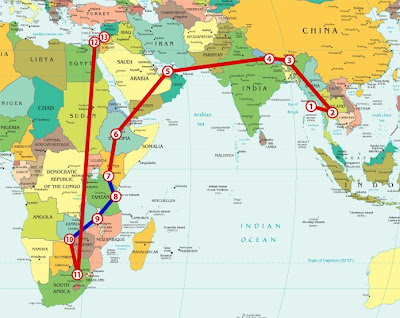
Okay, just because I was bored and had nothing better to do with my time, I made this map that shows all the places I'm going. Each of the circles with a number in it is a place I'm stopping, the red lines are routes I'm traveling by air, and the blue lines are routes I'm traveling overland. This is just the plan, of course, and it assumes that I won't come down with dengue fever or be taken as a political prisoner or anything like that.