
“Antigua! Antigua! Antigua!” Early this morning I rode a bright red Bluebird bus from Guatemala City to Antigua. A handful of locals occupied the remaining seats and samba music was the driver's choice today. “Antigua! Antigua!” The driver called out again to fellow Guatemalans waiting on the side of the road. Several of them pulled open the exit at the back of the bus and piled in, as a few more entered the traditional way. “Antigua! Antigua! Antigua!”The samba music blasted louder through the speakers. I was now sharing my seat with two other men and we were streching the limits of the number of people that a former US school bus is physically capable of holding. “Antigua!” The bus rumbled out of the city and through misty green hills as myself and the hundred-or-so other passengers headed towards Antigua.
If there are Spanish colonial towns in heaven, they'll look like Antigua. Antigua is so perfect and picturesque that my Lonely Planet book poses the question, “did they get somebody in to do all this stuff?” After dumping my stuff off at a hotel and having a quick breakfast of “Huevos y Salsa”, I was off to explore Antigua.
Antigua was the colonial capital of Guatemala for 200 years until it was razed by an earthquake in 1773. The capital was moved to Guatemala City, but many of the former structures were rebuilt and the result is a whole lot of prime spots for sightseeing. It was easy to enjoy wandering around the town with absolutely no agenda. After visiting a Spanish colonial cathederal or a giant 16th century ruin, I would look down the street one way and something would inevitably catch my interest. Then I'd look down the street the other way and there was another sight that was equally good. So I spent my time in Antigua being led through the streets by one amazing sight after the next, always with intentions of returning to the “equally good” sights that I left behind. A few of the places I visited included a Spanish cathederal called “Catedral de Santiago”, a monestary called “Iglesia y Convento de Nuestra Senora de La Merced”, and a former university called “Universidad de San Carlos” that has since been moved to Guatemala City. My favorite sights though were all the store fronts in Antigua. All of the newer structures are painted bright colors - either red, yellow, or blue, or pastel variations of the primary colors. It really was surreal to wander through endless streets of colorful storefronts filled with flowers and covered with the classic plaster-falling-off-bricks look. I got so caught up in snapping pictures of storefronts that I had to consciously tell myself to get a few pictures of something else.
 The town was amazing, but the reason I originally came to Antigua was to visit the still-active “Volcan Pacaya”. While I was in Belize my traveler friend Mark showed me pictures of dramatic black lava rock and red-hot rivers of flowing lava from his visit to the volcano. It took me only a few seconds to decide I had to see it and my itinerary had officialy been adjusted.
Pacaya did not disappoint. After a two hour drive out of town and a steep hike with a Guatemalan guide and a few other travelers, I reached the crater of Pacaya. Mist and clouds obscured everything at first and I thought I was just on the top of a tall mountain. Slowly, as my view cleared, I saw a massive black crater below me with a peak of lava rock towering hundreds of feet above. I rested with the group for a few minutes before our Guatemalan guide led us down the edge of the mountain and into the crater. I found out that climbing over lava rock is quite a challenge. I took slow, deliberate steps over giant, shaky masses of unsettled lava rock until I finally reached what I really came for.
Red, blazing lava oozed out of openings in the rock and I gathered with the others to watch. It really is amazing how captivating lava can be. Each of us stood just close enough so that we were uncomfortably hot, but not so close that the hair on our arms would cinge. Our guide explored the crater in the distance as I took turns taking pictures with the other travelers. I'm sure the poses we made have all been done before, but they were fun nonetheless. I stood from a distance and positioned my finger just right so that in a picture it would look like I was sticking it in the lava. I also made faces in front of the lava, straining to express (and embellish) the pain that came with standing only a few feet away from the molten mess.  Our guide called out to us. We followed him around a mound of rock until we saw his discovery. Oozing lava was entertaining enough, but now we had a small river of it to keep our attention. I must have taken the same picture of the river of lava ten different times, but each time it felt worthwhile because the sight was still so spectacular. After more poses and many more pictures it finally was time to go. Our guide hiked to the edge of the crater and called to us over and over until each of us pulled ourselves away from the lava. A short hike to the top of the crater revealed another incredible view: silhouettes of three volcanos in the distance surrounded by clouds and the orange and pink light of the sunset.
Wednesday, February 6, 2008
Antigua / Volcan Pacaya

Tuesday, February 5, 2008
Tikal
 When I woke up this morning I found it hard to believe that by the end of the day I would have crossed into Guatemala, spent several hours at Tikal, and ended the day on a night bus to Guatemala City. Logistically I knew it should work, but there wasn't much room for error. The beauty of having a loosely planned trip though is that stuff like that doesn't have to work. If it works then that's great, but if not then it just means I'll spend a day or two somewhere else.
After taking a water taxi from Caye Caulker to Belize City and buying a bus ticket to Tikal, I ducked into a low-key looking restaurant across from the pier named, “Maya Cafe”. The Maya Cafe turned out to be quite a mix of cultures and it was anything but Mayan. The owner of the place was a Chinese man named William Wang. I have no idea what this man is doing in Belize, but he speaks a mix of English and Spanish and does it all with a thick Chinese accent. Along with an American style breakfast, the menu featured egg-rolls and won-tons, among other Chinese dishes. I played it safe and had the ham and eggs. Eating at the place was just funny, I had a quick breakfast, used Mr. Wang's internet connection to e-mail home, and was intrigued by phrases that he yelled to his assistant back in the kitchen. “Hey amigo! Hot watta! Dos!”
The bus ride to Tikal was interesting enough. I was excited to see the contrast between the two countries as I crossed from Belize into Guatemala and I wasn't disappointed.
Elections in Belize are this week so the entire country is plastered with political posters, some more tasteful than others. There are two political parties that dominate the country, each of which is very opposed to the other. Whoever comes up with the political posters must have a thing for rhymes too. A few of the slogans included, “P.U.P Hire, U.D.P. Fire”, as well as “P.U.P. Thief, U.D.P. Belief”. Some signs were written in Creole and were pretty entertaining to read. One sign, which I assume refers to the hard lifestyle Belizians have had to endure due to money laundering by the current political majority, read, “Tings Haad, Tek Dem Money, Vote U.D.P.” Another, touting a specific candidate, read, “Wil wok fo de peepol.”
Guatemala has been a different flavor. The political signs were gone, but they were replaced by bumpy dirt roads and poverty that was impossible to miss (though it wasn't anything close to what I saw in India). The paved road from Belize quickly turned to a wide dirt road filled with potholes, yet it is still used by eighteen-wheelers that kick up massive clouds of dust. Several times we passed horses, pigs, and dogs wandering in the road. We also passed a few locals hauling goods on the backs of animals while trying to avoid the oncoming semi trucks and their clouds of dust.
Okay, now for the good stuff... Tikal was amazing. I only had three hours to explore the place before it closed for the day, but that turned out to be just enough time to see the most spectacular ruins. One thing that really surprised me about Tikal was that it's still in the middle of the jungle. After I bought my ticket I walked for a half-hour along a narrow path through giant trees and vines before I finally arrived at the first ruin, “Templo VI”. Although I was pretty anxious to get to the ruins, the walk was worthwhile. It really set the mood to wander alone through the jungle on my way to ancient Mayan temples. As I walked it was dead silent except for the calls of macaws, toucans, and spider monkeys hidden in the trees.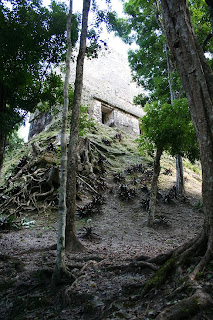
The stone ruins of the Templo VI towered above the trees and were a nice introduction for what was to come. After wandering past a separate group of ruins I came to the spectacular, trademark sight of Tikal, the Grand Plaza. Two temples rise above the trees on each end of the Grand Plaza and ruins line the sides in between. One of the temples, Templo I, is the most recognized of the ruins at Tikal. Templo I is almost completely intact and features a dangerously steep staircase that leads about one hundred feet up to the top of the structure. The terraced sides of the temple give it a distinctly Mayan feel.
After wandering around the Grand Plaza and trying to find all the greatest photo-ops, I made my way past Templo III to Templo IV, which is known for it's sweeping views of Tikal from the top. It just happened to be sunset, which was absolutely perfect and completely unplanned on my part. I sat down on one of the terraces of Templo IV and enjoyed watching the tops of Templo I, II, and III turn bright orange with the sunset. In every direction there was nothing but jungle all the way to the horizon. I can only imagine how incredible it would have been to have lived during the peak of that Mayan civilization. So the whole day I wondered about the logistics of seeing everything and being in Guatemala City, but fortunately it all worked out as planned. I was lucky to find a chartered taxi leaving from Tikal to Santa Elena that had one seat left - a seat that I was happy to fill. At Santa Elena I was hoarded by (friendly) touts anxious to sell me a ticket on the next night bus to Guatemala City. So as I write this I'm sitting on a smelly bus that looks like it hasn't been cleaned or maintained for thirty years, and one on which I'm the only white man out of fifty passengers aboard, but it's going to my destination and that's all that matters. With any luck I'll see the famous Spanish colonial town of Antigua tomorrow and climb the nearby Volcan Pacaya at night to watch dramatic rivers of hot, flowing lava.
Monday, February 4, 2008
Blue Hole

This morning I went out to the dock and waited with Mark for a local dive company that was going to pick us up. The boat came a little after 6:30 and we were off for Lighthouse Reef, where the Blue Hole is located. Lighthouse Reef is two hours by boat from Caye Caulker, directly East into the Gulf of Mexico. I spent the time resting on the boat, accompanied by three local guides and a handful of divers excited to see one of the most famous dive sites in the world.It was amazing to me that the boat driver knew where to go. For two hours we headed into the distance with nothing but ocean surrounding us on every side, but sure enough, after a couple of hours we arrived at the Blue Hole.
In all the pictures that are taken from the air the Blue Hole is quite a sight - and it's obvious that it's perfectly round. I wonder though how anybody even recognized it for what it was before seeing it from an airplane. The shallow reef sticking out of the ocean was spectacular to look at, but if I hadn't known beforehand I never would have guessed that the reef formed a perfect circle with a four-hundred foot hole in the center.
Diving the hole was a blast. It seems to get mixed reviews from people, which is understandable since there are hardly any fish to see, but I went with the understanding that I wasn't going for the wildlife and I thought it was spectacular. Our guide lowered slowly over an underwater ledge that led into the hole and as I followed him I could see nothing but blue water fading into black below me. After only a couple of minutes we had lowered to 130 feet, by far the deepest I've ever been while diving. I followed along with a few other divers as our guide led us through a series of massive stalagtites along one edge of the hole. I felt like I was in the middle of a dramatic underwater sequence in a James Bond movie, it was so out-of-this world. Like I said, everyone has different feelings about the Blue Hole, but I remember thinking at the time that it was by far the most intense and amazing dive I had ever done. The Blue Hole is different from other dives. People who dive the Blue Hole expecting to see incredible wildlife are only going to be let down. The Blue Hole is cool because the setting is so surreal. For a few minutes you're in a new, exotic world - different from any other dive and far different from anything on the surface.
After returning to the boat I enjoyed talking with the other divers about their experience as we cruised towards the next dive site. Our next destination was a reef just off an island called “Half Moon Caye”. The dive at Half Moon Caye, like the other dives I've done in Belize, was absolutely spectacular. Half Moon Caye was different though than Hol-Chan or, of course, the Blue Hole. The dive at Half Moon felt like a tour through a giant pet-store aquarium. The different shapes and varieties of coral were what made it so interesting. I had seen sea fans and other types of coral in home aquariums before, but I always assumed that those shapes were something dreamed up in the mind of whoever designs stuff for aquariums. After seeing all the coral at Half Moon I felt like the aquarium designer guy must have cheated; all he had to do was copy the amazing shapes from this dive site. I recognized a few shapes from imitations in home aquariums, but others were completely unexpected. Among the shapes I saw were giant green, red, and purple tubes made out of coral, massive bowls made completely of coral, and coral that looked like giant nests of crabs legs.
Lunch was chicken, coleslaw and rice on the island, followed by a walk through the jungle with Mark to see Half Moon Caye's famous “Red-Footed Booby “ birds. The jungle walk was a nice contrast to all the diving, it was refreshing to see wildlife on land for a change. We came to a lookout tower in the jungle and climbed it to observe hundreds of booby birds flying through the air. On the walk back we spotted a lizard in a tree that knocked bird poo all over Mark as he walked underneath it.
Our last dive was at a site called “The Aquarium” near and island called “Long Caye”. The Aquarium was similar to the dive at Half Moon Caye except that there were many more fish - hence the name, “The Aquarium”.
After arriving back at Caye Caulker I took a short nap and then met up with Mark for dinner - a barbeque on the beach by my Belizian friend Roger from the other night. Mark and I had a massive dinner of rice, garlic mashed potatoes, garlic bread, and barracuda steaks. Inevitably I always end up talking about religion while I'm traveling; it seems to be the one defining factor that sets me apart the most from people I meet. Mark and I had a short conversation about Mormonism that was followed by one about politics in the United States (those always seem to be the two hot topics with foriegners who meet a Mormon kid from America). Mark and I also talked about the cost of living in the United States versus the cost of living in London. Mark was amazed how affordable it is to own a four or five bedroom house in the United States. I've always believed that life in the United States has its advantages that way, but talking with Mark really confirmed that. Mark has a law degree from Cambridge and a good job waiting for him at a law firm in London. Mark is as sucessful as young British people come and he still would have a hard time maintaining a standard of living that is completely achievable in the United States.
Anyway, as much fun as Belize has been, I think I'm going to move on tomorrow. One thing I've learned about myself while traveling is that I always like to be on the move, and this trip is no different. Tomorrow morning I'm taking a bus to Tikal and after a visit in the afternoon I'm going to try to catch a night bus to Guatemala City. Mark showed me some amazing pictures from Pacaya Volcano, near Guatemala City, and I've decided that I absolutely have to see it. I'm excited for this trip. My itinerary seems to change a little every day, but I think that it's for the best. This trip is going to be awesome, I'm so excited for it all to work out.
Sunday, February 3, 2008
Hol-Chan Marine Reserve
 This morning I headed to "Frenchie's Diving" to arrange a diving trip for the day. Fortunately I showed up just as a boat was about to leave for the day and I headed off with a lady from San Francisco, a kid named Mark from London, and our Belizian guide, Jose. We headed out on the boat about thirty minutes away to a dive site called "Hol-Chan Marine Reserve".
Diving at Hol-Chan was a blast. At a good dive site it really feels like you've discovered an entirely different world. I buddied up with Mark and we put our gear on and lowered down about sixty feet to the ocean floor. Hol-Chan is known for it's underwater canyons that are covered with coral. The canyons are appropriately called, "coral canyons". Jose and Farrah (the lady from San Francisco) met up with us at the bottom of the ocean and we were off to explore the canyons. Just seeing the coral and sea fans that covered the canyon walls was interesting enough, but the wildlife down there really was pretty incredible. The highlight of that first dive was encountering a giant eagle ray. Jose spotted the eagle ray off to our right and I swam over so that I was right over it's path. As I looked down the eagle ray passed directly underneath me. It was amazing how huge the thing was, it probably was ten feet long from head to tail with a body about five feet wide. I followed the ray for a few minutes and then looked over at Mark, who was pointing at something behind me. I looked behind me and there was a second giant eagle ray coming right towards me. The second ray passed right underneath me and turned towards the first one. I chased after the two rays for a few minutes and watched them as they swam side by side. Finally it occured to me that I had drifted pretty far away from Jose and the rest of the group, so I left the eagle rays and hurried to catch up with everyone.

While diving it's important to budget enough time between dives to allow your lungs to rid themselves of compressed air that is breathed in while underwater, so to pass the time we did some snorkling in shallow waters. As we pulled up to a reef about six feet underwater, three nurse sharks came right up to the boat and lingered there as if they were waiting for something. Jose said the sharks are harmless, but that sometimes tourists will throw food to them, so they usually will come right up to boats and wait around for food for a few minutes. As far as snorkling goes, Hol-Chan really is world-class. I remember that I absolutely loved Hunama Bay in Hawaii, but Hol-Chan is easily the best snorkling I've done since then. Besides the hoards of fish covering the reef, I also chased after a couple of nurse sharks (they were ridiculously faster than me, even with my fins on), and I saw a particularly nasty looking baracudda. Our second dive of the day was spectacular. It started out ordinary enough, but after only a few minutes we came across a nurse shark resting sixty feet down on the ocean floor. A bit further along Jose motioned towards something and I looked to my right and saw Mark chasing a giant sea turtle. I joined in the chase and absolutely hauled after the thing, but for some reason creatures that are born in the water can swim a whole lot faster than I can. I couldn't even dream of keeping up with the turtle and barely got one picture of it before it swam into the distance. Jose seemed to know right where to look to find the good stuff and before the dive was over we saw a giant eel hiding in a crevass and handled a wild lobster that Jose found on the ocean floor. After all that chasing I was running low on air, so I surfaced a few minutes early and met up with everyone back on the boat.Diving really takes it out of you. I was so hungry when I got back this afternoon, but all I wanted to do was lay down and take a nap. After relaxing a little bit I downed a lobster burrito, some pineapple cake with caramel, a piece of banana bread, and two chocolate-chip coconut cookies. Finally I collapsed under a palm tree and drank out of my water bottle as I enjoyed the breezy weather. A couple dread-locked locals rode by on their bikes and couldn't resist a few comments. "Hey, wake up mon!" shouted one.
"It's morning-time! Welcome to America!" (I'm not sure what that was supposed to mean).
Tonight I met up with Mark and watched the Super Bowl at a local sports bar. Mark and I had a pretty detailed conversation about American football and the professional football leagues in Europe and Britain. It was actually pretty fun to explain to Mark what the four downs mean, what constitutes a penalty, and the difference between an extra point and a two-point conversion. Mark just finished studying law at Cambridge and has spent the last nineteen months traveling the world (yeah, the British really know how to travel). Tomorrow I'm going on three dives, one of which will be at the famous "Blue Hole". I'm pretty excited for the Blue Hole, as that's the whole reason I came to Belize and a lot of the reason why I came to Central America. This place is just so laid-back and fun. I've already met two Americans who came to Caye Caulker and have stayed for years, if that's any indication of how fun the lifestyle is down here. As much fun as that would be, I'll probably be coming home in a few weeks anyway. For now though I'm looking forward to the Blue Hole and all the rest of the good stuff in Central America.
Saturday, February 2, 2008
Caye Caulker
 Belize is like Newport Beach with a third-world, Caribbean twist. I arrived in Belize City at 3:00 this afternoon and headed straight for the pier to catch a water-taxi to Caye Caulker (prounounced, "Key Caulker"). I knew I was really on vacation when the water-taxi left for the island. It was fun just to sit back and enjoy tropical, summer weather at the beginning of February. On the way out the wind rushed past my face as we passed several lush, green islands. I even saw a manta ray leap out of the perfect, turquoise water.
Caye Caulker is a lot of fun. Most tourists head to Ambergris Caye, which has upscale resorts and is more geared towards tourists. Caye Caulker is a big mix of tanned backpackers and laid-back locals. My favorite part of the island is all the store fronts. Bumpy dirt roads criss-cross the island and are lined with brightly colored buildings that house shops, restaurants, and guest houses. As I wandered down the roads this afternoon I passed Belizian kids on their bikes, a lady with a massive colored afro braiding her friend's hair, and a local man peddling his artwork and asking passers-by if they want any "Ganja".
The locals here are hilarious. They really are the most laid back people. It's funny though to see some of them try to sell their stuff with such a mellow attitude. I passed one guy who was having a barbeque on the beach later tonight. He came out to me and said, "Hey mon, you hungry?"
"No", I said.
"You gotta eat!"
"Not tonight."
"If you don't eat you gonna fall over, mon."
Later I changed my mind and went back to the same guy to arrange to eat at his barbeque. "Remember me?" I said.
"Yeah, you're the guy who says you don't eat."
Dinner was three lobster tails with mashed potatoes and rice and garlic bread. Lobster is as cheap as fish down here because it's so easy to catch. I met a couple from Colorado and chatted with them as we had barbequed lobster. This place is just way laid back and mellow, I'm so excited to spend the next few days here diving, having barbeques on the beach, and snapping pictures of the classic Caribbean culture.


